To get us nicely warmed up before the lecture that Nina Simon will give at the Museu Picasso on Wednesday 17 November, we offer you a review of her widely acclaimed book. The concept of public participation is associated above all these days with the track opened up by social media. And it’s true that the social networks provide endless options to share, comment, recommend, co-create and, in short, participate so easily and so immediately that we’re still getting used to. But the idea of participation goes far beyond the Web 2.0. The museum visitor, now accustomed to being an agent in the virtual environment must also be offered channels of expression and participation in the physical environment of the museum.
With a rigorous methodology, in The Participatory Museum Nina Simon presents the different stages of participation museums can offer. Ideas, recommendations on what to do and what not to do, a myriad of examples of good practice in museums around the world, together with the occasional failure, make this a bedside book for present-day museography.
Nina Simon
Every museum, every cultural centre, depending on the typology of its holdings and, above all, in harmony with its mission and objectives, will find here ideas and proposals of real value. Some are very simple, such as simply encouraging visitors to express their opinions by making a computer available or a voice recorder on which to leave their message. The fact is that something so relatively simple to put into practice is far from common in our museums. It makes me wonder why a habit that is so widespread on the Internet is still not happening in the physical museum. If we are in favour of participation, why are we limiting it almost entirely to the virtual environment?
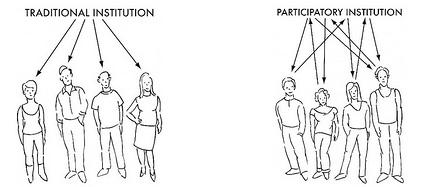
Illustration from The Participatory Museum
What is a participatory museum? The author defines a participatory cultural centre as “a place where visitors can create, share and connect with each other around content” (the collection). Participation is not an end in itself, it’s a strategy. The aim of participatory techniques is to satisfy the visitor’s desire to be actively involved and to do so in a way that projects the mission and values of the institution forward and outward. The implementation of participatory techniques breaks down such deep-rooted ideas as that museums never change and so if you’ve been round once there’s no reason to visit it again, or that the authorized voice of the centre does not embrace the perceptions of the visitors. 6 flashes of the book The book is very rich in content and I strongly recommend reading it attentively. As a taster, here are some of its reflections and proposals:
- A museum or a cultural centre is a platform that provides opportunities for diverse experiences co-produced by the visitors.
- The more accustomed people are to participatory learning and experiences, the more they want something more than simply to attend a cultural event or institution.
- Good participatory practice is not just giving the visitors a say but helping them develop experiences that are of value and interest to everyone.
- In many cases, if some participatory proposal fails to produce the results the museum was hoping for, it is the fault not of the visitors but of bad design (design here being everything from idea to realization).
- There are three agents for whom the experience must have interest, meaning, value: the actual participants, of course, the non-participant visiting public and the museum.
- There is a need to shift our gaze, to focus it on the visitor and ask ourselves some questions: What does our audience want? What is the museum prepared to give? What organizational changes will the adoption of participatory projects entail? How do we assess the results of participatory experiences?
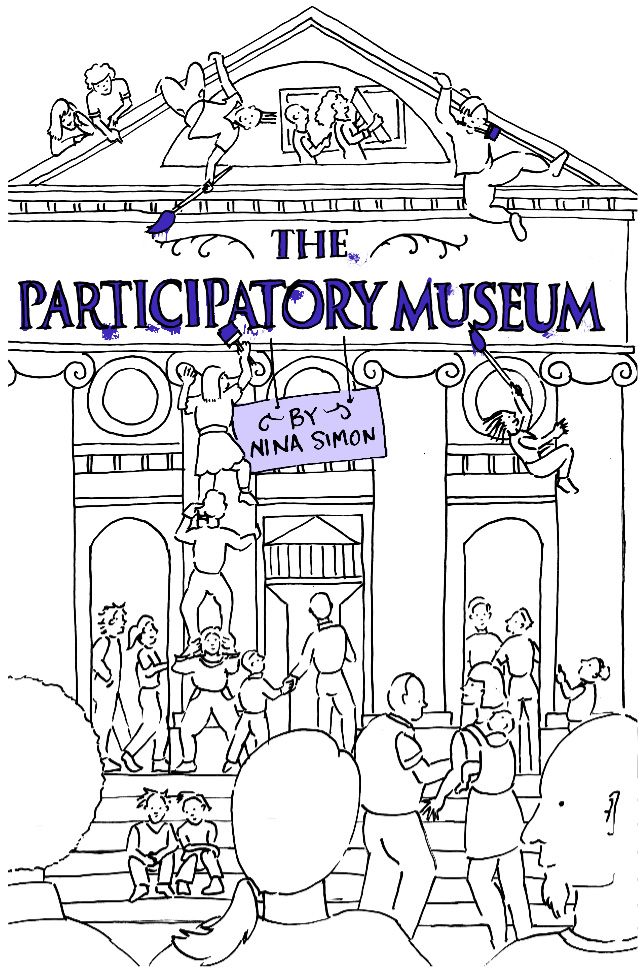
Cover of The Participatory Museum
Participation in art museums, too It’s true that participation and experimentation are easier to achieve in science museums and history museums, but art museums can also do a lot to a visiting experience of more quality. In the words of the author: “The idealistic mission statements of many cultural institutions — to engage visitors with heritage, connect them to new ideas, encourage critical thinking, support creativity and inspire them to positive action— can be attained through participatory practice”. This is also very much the case with art museums. The book provides good examples from the Tate, Brooklyn, Hirshhorn, Cantor Art Center, San Francisco Museum of Modern Art, Victoria & Albert and Rijksmuseum. Among the cases of good practices we note with pride the reference to the participatory experience developed by the Museu Picasso with the Eina School of Art and Design. The book, an example in itself of a participatory writing process The actual process of writing the book was in itself a model of participation: once the author had completed a first draft, she put up a wiki on which professionals from museums around the world could contribute our critical readings, comments and examples. The website also encourages readers to keep on contributing comments and ideas: these will be taken into account in future updates of the text. You are all cordially invited to have your say here or post your comments on the book discussion space. You can read the book online, for free, at www.participatorymuseum.org/read See other reviews of the book Conxa Rodà Project Manager As a visitor, have you taken part in a participatory experience that you’d like to share with us? If you work in a museum, have you implemented any participatory projects in your centre?


